

From Planning to Execution: Mastering WBS, Gantt Charts, Resource Planning, and Critical Path Analysis


Building the Foundation with a Work Breakdown Structure (WBS)

When you structure a project for execution, you should begin with the Work Breakdown Structure (WBS), because it is the foundational architecture that defines what must be done before addressing when or how it will be done. A WBS is essentially a hierarchical decomposition of the total scope of work into manageable deliverables and sub-deliverables, ensuring that nothing critical is omitted and that complexity is systematically reduced into controllable components.
At the highest level, I define the project deliverable in its entirety. From there, I progressively break it down into major phases, work packages, and finally into individual tasks.
This hierarchical logic is not arbitrary, it follows a decomposition principle where each lower level represents a more granular and actionable layer of work. For example, in a product development project, the top level might be “Product Launch,” followed by phases such as “Research,” “Design,” “Development,” “Testing,” and “Deployment.” Each of these is further decomposed into work packages like “User Research Interviews” or “Prototype Development.”
A well-constructed WBS serves multiple strategic purposes:
First, it clarifies scope boundaries, reducing the risk of scope creep by explicitly defining what is included and excluded.
Second, it provides the structural basis for all subsequent planning tools, including scheduling and budgeting.
Third, it improves accountability by assigning ownership at the work package level, which becomes essential for tracking execution performance.
From a managerial perspective, I treat the WBS as a control mechanism. It ensures that every deliverable is traceable to a specific task and ultimately to a measurable outcome. Without this structure, project execution becomes fragmented, and coordination across teams deteriorates. The WBS also enables more accurate estimation of time, cost, and resource requirements, because each component can be assessed independently before aggregation.
In essence, the WBS is not merely a planning artifact, it is the backbone of disciplined project execution. Once established, it becomes the reference point for all scheduling, resource allocation, and risk analysis activities that follow.
Translating Structure into Time with Gantt Charts and Scheduling Logic
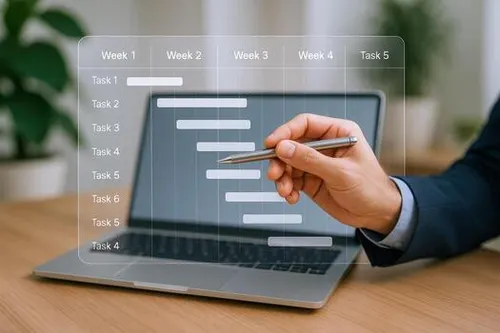
Once the Work Breakdown Structure is established, the next step is to translate it into a temporal framework using Gantt charts. A Gantt chart is a visual scheduling tool that maps project tasks against a timeline, allowing me to understand not only what needs to be done, but also when and in what sequence.
Each task derived from the WBS is placed on a timeline with defined start and end dates. However, the real value of the Gantt chart lies in its ability to represent task dependencies. These dependencies, such as finish-to-start, start-to-start, or finish-to-finish relationships, define the logical flow of execution. By mapping these relationships, I can immediately identify sequencing constraints and ensure that no task is scheduled in isolation from its prerequisites.
In practice, I use Gantt charts to establish a realistic execution rhythm. Tasks are not simply placed sequentially; they are optimized for overlap where possible to reduce total project duration. This introduces the concept of parallelization, where independent work streams are executed simultaneously. However, this must be carefully balanced to avoid resource bottlenecks, which is why scheduling and resource planning are tightly interconnected.
Another critical function of the Gantt chart is milestone definition. Milestones represent key checkpoints in the project lifecycle, such as completion of design, approval stages, or deployment readiness. These milestones are essential for monitoring progress and ensuring alignment with strategic objectives. I use them as control points for performance evaluation and stakeholder reporting.
From a governance perspective, the Gantt chart becomes a communication tool. It provides stakeholders with a clear visualization of progress, dependencies, and potential delays. When managed effectively, it supports proactive intervention rather than reactive correction.
Ultimately, the Gantt chart transforms the structural clarity of the WBS into a time-bound execution roadmap, enabling disciplined delivery and predictable project outcomes.
Optimizing Execution with Resource Planning and Critical Path Analysis

With structure and scheduling in place, the final layer of execution planning involves resource allocation and critical path analysis. These two components ensure that the project is not only well-designed but also operationally feasible under real-world constraints.
Resource planning involves identifying, allocating, and optimizing the use of human, financial, and technical resources across all project tasks. I begin by mapping required competencies to each work package defined in the WBS.
This ensures that the right skills are assigned to the right tasks, minimizing inefficiencies and rework. Resource availability is then compared against demand, often revealing conflicts or overallocations that must be resolved through leveling techniques or task rescheduling.
Financial resources are equally important. I align budget allocations with project phases to ensure liquidity and prevent funding bottlenecks. In more complex projects, I also incorporate capacity planning to ensure that infrastructure, tools, or systems are available when needed. Effective resource planning ensures that execution is not theoretically sound but practically achievable.
Critical path analysis (CPA) adds another dimension of control. The critical path represents the longest sequence of dependent tasks that determines the minimum project duration. Any delay in a critical path task directly impacts the overall project timeline. By identifying this path, I can prioritize monitoring and risk mitigation efforts on the most time-sensitive activities.
In practice, I continuously monitor slack (or float) within non-critical tasks. This flexibility allows me to reallocate resources dynamically without jeopardizing project deadlines. When risks emerge, I focus mitigation strategies on protecting the integrity of the critical path.
Together, resource planning and critical path analysis ensure that execution is both efficient and resilient. They convert a theoretically well-structured plan into a controllable system of coordinated action, where time, cost, and scope are actively managed rather than passively observed.
Visit https://lnkd.in/dMyQNrgd and contact me to know more about how i can help you with this!
Check out my blog:➡https://lnkd.in/dZMbXC9R
For Consultancy Services:➡https://lnkd.in/dMyQNrgd
©Iuppiter International Consulting. All right reserved.


Comments